Notes from manual
The Single-Ended interfaces have (‘active’) terminators built in, enabled by a switch. All pods have TERMPWR enabled by a switch.
Manufacturers
This model is branded under “Ancot”, but may have also been manufactured under the “Teledyne” or “LeCroy” brands.
Data Sheet
ANCOT DSC-216 SCSI Logic Analyzer
The ANCOT SCSI Bus Analyzer/Emulator, Model DSC-216, is a tool for the development, integration, and repair of SCSI devices. This instrument can monitor and portray on the screen every facet of information about SCSI operation of the monitored SCSI environment. The display format is in plain English for ease of understanding. The DSC-216/FxE can be used as a SCSI Initiator (host) emulator, programmed for manual or automatic testing. Packaged in a small lightweight portable briefcase, it is exceptionally well suited for field applications where portability and high reliability are important.
HIGHLIGHTS
• Passive SCSI-2 FAST 8 WIDE Synchronous/Asynchronous tracing • Optional SCSI-2 FAST & WIDE Synchronous/Asynchronous Initiator emulation • Tracing of data transfer rates over 10 MHz. • Trace memory: 32K events standard, 128K or 512K optional • REC/ACK recording, all four edges • Powerful high level triggering capability • Single-Ended or optional Differential SCSI electrical interface • Embedded operating system • Optional C language programming capability for SCSI Initiator emulator
ADDITIONAL SPECIFICATIONS
• SCSI-1 &2, FAST/WIDE Tracer • SCSI-1 8 bit and SCSI-2/3 8/16 bit support, over 10MHZ transfer rate • Passive tracer. Only signal changes are stored • Circular 32K Event Trace memory standard, 128K or 512K options. • Up to three external signals (from the tested device) can be recorded together with SCSI signals in the trace memory. Input for external clock provided. • Event time-stamping of over 200 seconds before wrapping around, with 20 nanosecond resolution. • Display of data count in data phase • Multiple recording modes including all/skip data, filtering by SCSI ID#, REQACK signal / four edges and SCSI phase changes • Start - Pause - Stop tracing capabilities • Powerful multi-level menu selectable triggering includes pre, post, standard, delayed, internal and external modes. • Connectors for external trigger input or synch output SCSI-2 FAST/WIDE EMULATION
Models with SCSI emulator use VLSI SCSI controller and function as an initiator with user programmable SCSI ID#. Interactive emulation is controlled from pre-programmed SCSI command set in EEPROM. Support for SCSI-2 FAST & WIDE (16 bit), custom SCSI commands, program macros, various SCSI device types provided.
Manual
on Bitsavers, rev 2.1, for 216/217
Portable_SCSI_bus_ANALYZER_Models_DSC-216_217_Users_Manual_Rev_2.1_199308.pdf
on Internet Archive, rev 2.5, for 216 only
on ArtisanAG side, rev 2.5.2, for 216 only
Teledyne-LeCroy-Ancot-DSC-216-FD-SCSI-Logic-Analyzer
DSC-216 vs DSC-217
The Ancot DSC-217 is the DSC-216 without the built-in screen, keypad, and keyboard connector. From the manual, page 6:
1.7 FRONT PANEL
The front panel of the DSC-216 contains a flat panel display screen, a 24-key keypad, two pushbutton switches, and 31 LED indicator lights. Several connectors, a cooling fan, and the main power switch module also share the front panel. The DSC-217 is configured the same, except it does not have the built-in screen and keypad.
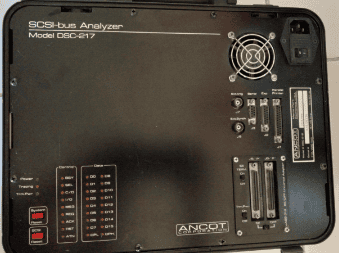
Ancot DSC-217 - from https://www.ebay.com/itm/126148108832 (and now mine!)
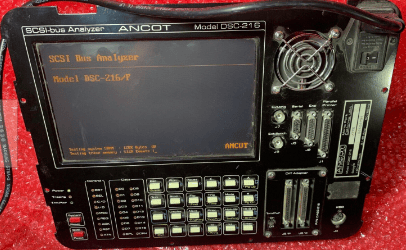
Ancot DSC-216 - from https://www.ebay.com/itm/125388243713
Connectors and SCSI capabilities
SCSI capabilities, referred to as “alternatives”, are decided with separate modules that are plugged in to the lower-right corner. Some are listed in the manual section A.3:
SA-216, OP-SA/216 - SINGLE-ENDED INTERFACE
SINGLE-ENDED interface, with high-density 68-pin ‘P’ type connector JS for WIDE SCSI, and Centronics style SO-pin ‘A’ type connector J6 for SINGLE-BYTE SCSI (standard type, is shipped from the factory)
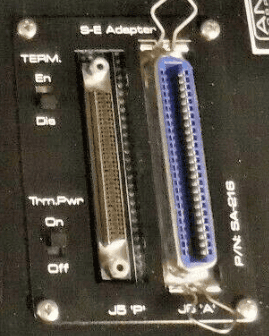
https://www.ebay.com/itm/123925267226
OP-SA68/216 - SINGLE-ENDED INTERFACE
With two 68 pin P-type for WlDE SCSI.
DA-216, OP-DA/216 - DIFFERENTIAL INTERFACE
DIFFERENTIAL interface, with same type connectors as SA-216. Optional.
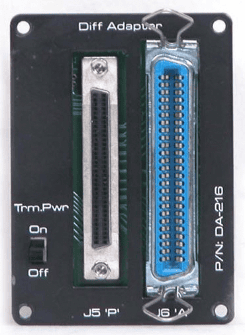
OP-DA68/216 - DIFFERENTIAL INTERFACE
Same as OP-DN/216, but with two 68-pin connectors.
DA68-216 - DIFFERENTIAL INTERFACE
DIFFERENTIAL interface, with two P-type connectors. HVD only, cannot be switched to LVD or SE.
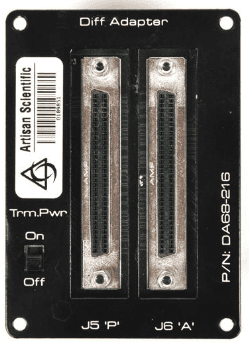
UA68-216, OP-UA68/216 - COMBINATION SINGLE-ENDED & DIFFERENTIAL INTERFACE
SINGLE-ENDED (JS) & DIFFERENTIAL (J6) interface combination, with two high-density 68-pin ‘P’ type connectors for WIDE SCSI (2 bytes). Optional.
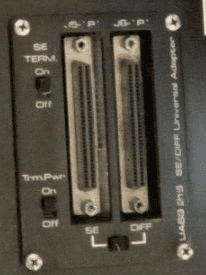
https://www.ebay.com/itm/126148108832
OP-UA50/216 - COMBINATION SINGLE-ENDED & DIFFERENTIAL INTERFACE
****with two highdensity 50-pin connectors for NARROW SCSI.
UA50C-216, OP-UA50C/216 - COMBINATION SINGLE-ENDED & DIFFERENTIAL INTERFACE
SINGLE-ENDED (JS) & DIFFERENTIAL (J6) interface combination, with two high-density 5O-pin Centronics-type connectors for single byte NARROW SCSI, as used on Sun Microsystems computers. Optional.
PBDSCB216-02
This is not mentioned in the manual, found on eBay.
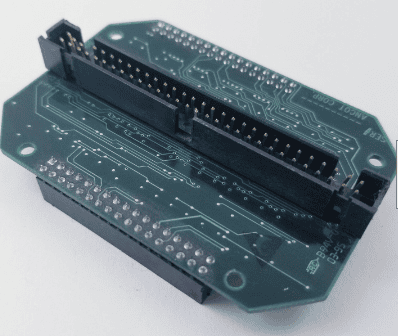
https://www.ebay.com/itm/203489938180
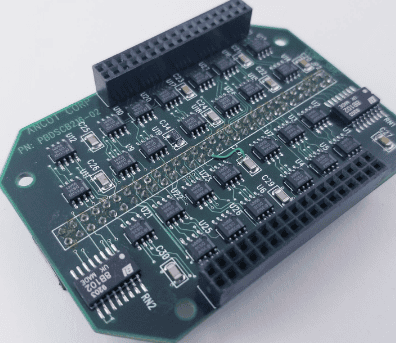
https://www.ebay.com/itm/203489938180
Unknown “alternative, but the transceiver ICs (DS3695 Multipoint RS485/RS422 Transceiver) suggest it is an LVD (Low-Voltage Differential) module since the DS3695 is limited to +12v and HVD (High-Voltage Differential, aka simply “differential” in the olden days) has a signalling level of +15v.
The “BI 9203 8B102” IC is likely a 1K- resistor pack.
Notes from manual
The Single-Ended interfaces have (‘active’) terminators built in, enabled by a switch. All pods have TERMPWR enabled by a switch.