Logo and Trademark
 Trademark filed Jan 2, 1990, registered Jun 25, 1991, cancelled Nov 23, 1992. (from USPTO)
There was also a similar Trademark filed around the same time for “D Cassette”, with the use for “computer peripherals; namely, cassette tape streamers, data cassette tapes for streamers”.
The “D Cassette” mark was used at least twice, on the Maxell CS-600SX and TEAC CT-600F.
D/CAS Tape List (incomplete)
| Manufacturer | Model | Standard | Capacity | Sources | Notes |
|---|---|---|---|---|---|
| NCR | 282’ Digital Data Cassette 279802 | ||||
| Maynstream | 600XD | 600 MB | |||
| HP | 9162-0050 Digital Cassette | http://agfabasf.com/en/catalog/other/data-cassettes/ http://www.hpmuseum.net/display_item.php?hw=675 https://www.ebay.com/itm/225629642679 | |||
| Burroughs | Certified Digital Cassette | ||||
| BASF | Compusette II | Do not confuse the original 15m Compusette or the “Compusette I” with the “Compusette II”. The originals is NOT D/CAS, it does not have a notch on the top. | |||
| Maxell | CS-500 | 200 MB | PC Magazine June 1986, page 224 | ||
| Maxell | CS-500HD | http://agfabasf.com/en/catalog/other/data-cassettes/ | |||
| Maxell | CS-600 | ||||
| Maxell | CS-600SX | ||||
| Maxell | CS-600XD | D/CAS-86 | 155 MiByte | ||
| TEAC | CT-90 Instrumentation Tape | http://agfabasf.com/en/catalog/other/data-cassettes/ https://www.ebay.com/itm/225187059499 | |||
| TEAC | CT-450 | 20 MB | PC Mag, June 1986, page 244 | ||
| TEAC | CT-500 | 20 MB | PC Mag, June 1986, page 244 | ||
| TEAC | CT-500H | ||||
| TEAC | CT-600 | ||||
| TEAC | CT-600F | D/CAS-103 | 600 MiByte | micha.freeshell.org/tape/Tech_DCAS.html | |
| TEAC | CT-600H | D/CAS-25 | 60 MiByte | micha.freeshell.org/tape/Tech_DCAS.html | |
| TEAC | CT-600N | D/CAS-85 | 155 MiByte | ”micha.freeshell.org/tape/Tech_DCAS.html https://www.ebay.com/itm/133559767950” | |
| Maynard | Data Cassette 600 | 600 MB | |||
| Maxell | DC-300 | http://agfabasf.com/en/catalog/other/data-cassettes/ | |||
| ORWO | Digitalkassette DK Typ490 | http://agfabasf.com/en/catalog/other/data-cassettes/ | |||
| Verbatim | H-150NH | http://agfabasf.com/en/catalog/other/data-cassettes/ | |||
| Maxell | M-90 | ||||
| Verbatim | R-300H | http://agfabasf.com/en/catalog/other/data-cassettes/ | |||
| Verbatim | ST-500 | ||||
| Verbatim | ST-600 | ||||
| Verbatim | ST-600XD | 155MB/160MB | |||
| Verbatim | T300 | ||||
| Verbatim | T300h | https://www.ebay.com/itm/334627147206 | |||
| Verbatim | T300nh | https://www.ebay.com/itm/266260356790 |
Transclude of DCAS-Tape-Types.base
D/CAS Type Breakdown
D/CAS-5
Not much information on this. There are references to the standard, but I can’t find information on any released products which use D/CAS-5.
Reference to it in relation to QIC-021: Computer Design - Google Books.
Reference to 20MB capacity: Tape Streamer Drive from nbn Elektronik - computerwoche.de
Their Data Cassette Drive Compatibility ( D / CAS ) group has arrived at D / CAS 5 , which makes cassettes…
D/CAS-6
SETTING STANDARDS
UNLIKE most computer peripheral industries, the cartridge-tape manufacturers have established some standards that make the interchange of data between machines not only possible, but practical. The working group for data cassette compatibility, D/CAS, has established several standard recording and interface standards that it hopes will promote the use and acceptability of cassette-tape products.
The hardware standard is called the QIC-02 (quarter-inch cartridge). The standard provides a minimal interface for the drive’s basic functions but still allow a great deal of variety in implementing special functions. It works with a majority of existing controllers and provides a basis for system designers who don’t want their products to be made obsolete by improvements in backup technology. A system with a QIC-02 interface should prove to be a safe bet.
For those who want to ensure that data recorded on one cassette machine can be accessed by another machine-perhaps in another system at a later data-the QIC-24 specifies a precise recording format. This 9-track Standard includes a reference burst on track zero that individual drives can use for dynamically aligning the head before playing data back. This reference burst will reduce off-track errors that occur over time. The format is group-coded recording (GCR), which uses two 4-bit nybbles encoded into a 5-bit word. Each W shown in Fig. A denotes a 5-bit word.
Laying out the tracks in a serpentine fashion (Fig. B) puts the beginning of track 1 at the same end of the tape as the end of track 4. This allows the drive to continue reading or writing data without waiting for a costly tape rewind.
The D/CAS group has also introduced a variation of the QIC-24 standard, called D/CAS-6. It defines a 4-track tape, preferred by some ¼” cartridge tape users. This standard has been submitted to the American National Standards Institute for consideration as a standard.
For more information on the QIC standards or D/CAS group, contact Freeman Associates, 311 E. Carrillo St., Santa Barbara, CA.
D/CAS-15
Found reference while looking for information on QIC-362):
With out MT-2ST and CT-600H cassette tape we’ve made a giant leap over the competition. It’s 90 ips performance can back-up an incredible 60 megabytes in only 12 minutes. And this is data on a media that’s totally interchangeable from drive to drive.
- Advertisement in Mini-micro Systems, Volume 21 from July 1988
D/CAS-25
Example media is TEAC CT-600H. 9 tracks, 60 MiByte capacity.
D/CAS-43
This document says:
- 50 MB
- Tape vendors: Maxell 184720
D/CAS-85/86
D/CAS-85: 17 tracks, 155 MiBytes D/CAS-86: 17 tracks (16 serpentine + dir), 155 MiBytes
D/CAS-85 and -86 are often referenced interchangeably. Since they have the same capacity, it’s likely they have the same layout but use media different formulations.
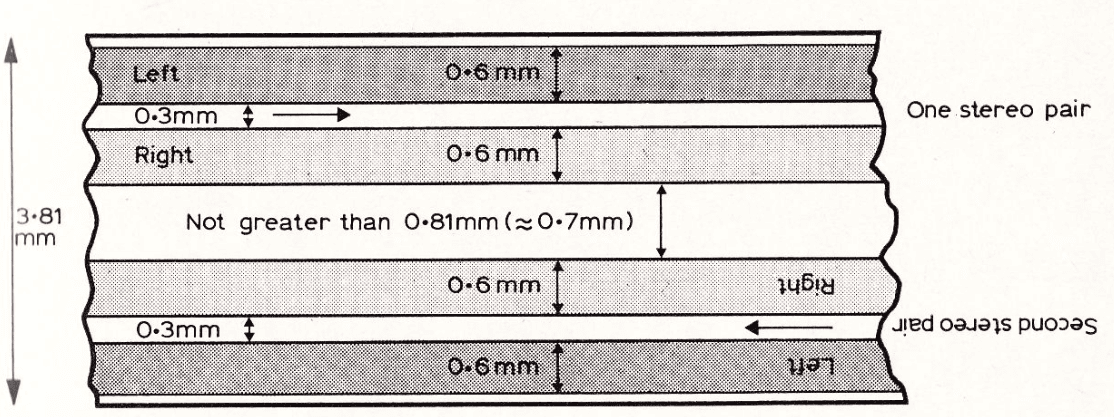
Tape is 0.15 inches (3.81mm) wide.
Relation to audio cassette tracks
For MONO AUDIO cassette, each track is 1.5mm wide, plus an unrecorded guard band of 0.7mm between each track.
For STEREO AUDIO cassette, each mono track is divided in to separate tracks of 0.6mm wide with a guard band of 0.3mm.
The remaining width on the outside edges of the tape is 0.055mm each side (0.11mm total)
Calculation for 17 tracks.
D/CAS-85/86 has 17 tracks.
At most 0.224mm is available for each track and guard (excluding possibility of edge gap).
The D/CAS head-unit has two individual heads.
Width of the physical head is 6mm. The gap in an audio cassette is 10mm. This means the head can move 4mm, enough to cover the while tape (obviously).
D/CAS-103
Example is TEAC CT-600F. 21 tracks, 600 MiByte capacity.
Drives
See Drives.
Definity Audix Voicemail system
The MT2ST/N50 was used in the Definity Audix Voicmail system, with CT-600F 600MB tapes.